Nobody plans a memorial service twice in a row. Most people do it once, while grieving, on a timeline they did not choose, for someone they loved. Then they never do it again.
So the questions are always the same, and there is nothing embarrassing about any of them. These are the ones families actually ask us, on tours, on the phone, and in the middle of a Tuesday afternoon when they have realized they have no idea where to start. Here are honest answers.
Timing and format
How soon after a death should we hold a memorial service?
There is no rule, and you almost certainly have more time than you think. Many families hold a service several weeks or several months after a death. If there has been a cremation, the clock that families imagine is ticking is not really ticking at all.
Waiting has real advantages. It gives out-of-town family time to book flights rather than scramble. It gives you time to grieve a little before standing in a room full of people. And it lets you plan something that reflects the person rather than something you assembled in four days.
The families who look back most contentedly are usually the ones who gave themselves room.
What is the difference between a funeral, a memorial, and a celebration of life?
A funeral usually happens soon after a death, follows a religious or cultural structure, and often has the body present. A memorial service happens later and does not have the body present. A celebration of life is the most flexible of the three, built around honoring how someone lived rather than following a fixed rite.
Plenty of families do two: a small private burial or funeral for immediate family, then a larger celebration of life weeks later for everyone else. If you want the sequence laid out properly, we wrote a longer piece on how to plan a celebration of life, step by step.
How long should the service be?
The formal part is usually 45 to 90 minutes. Beyond that, attention fades and the people who are holding themselves together start to struggle.
The gathering afterward is a different matter and often runs two to three hours. That is where most of the actual comfort happens, over food, standing in small groups, telling the stories that never make it into a eulogy. Plan the ceremony tight and the gathering long.
Do we have to hold it indoors?
No, and many families deliberately do not. A room with a ceiling and a podium is the setting most people picture, but it is not the only option and often not the best one.
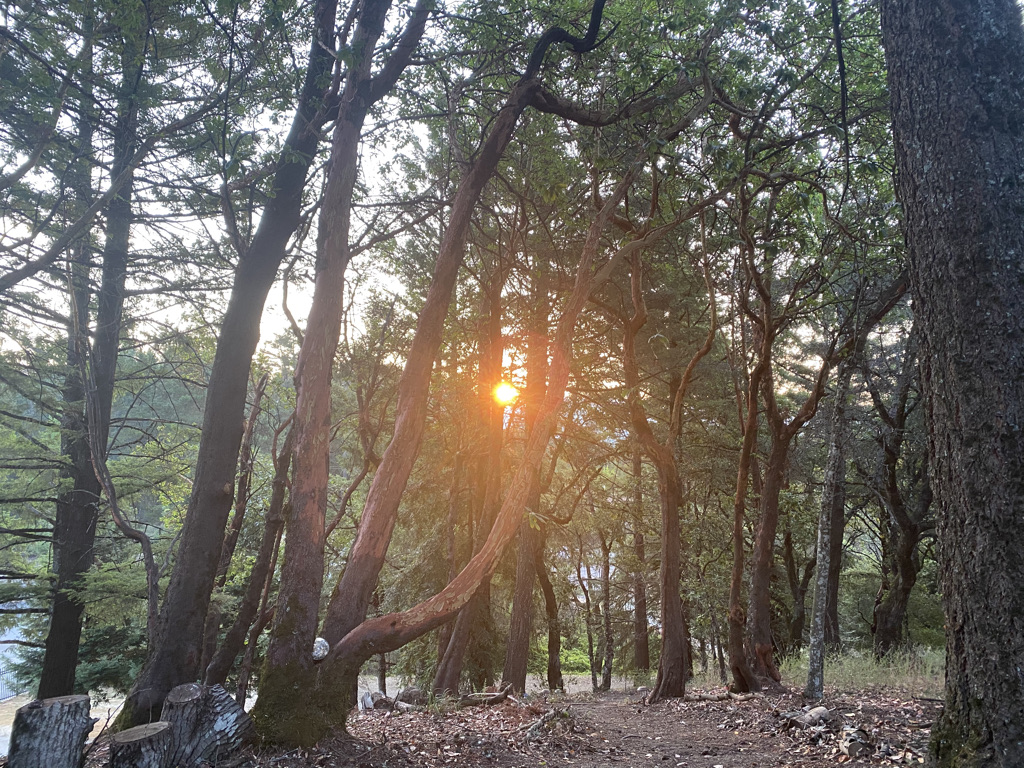
There is something about open sky, trees, and moving air that makes grief easier to carry in public. People cry more freely outdoors and feel less watched doing it. We wrote separately about why an outdoor setting helps us grieve, because it is the thing families comment on most afterward.
The ceremony itself
Do we need a religious officiant?
No. A memorial service does not require clergy, and there is no legal or official requirement about who leads it.
Your options are wider than most families realize: a family member, a close friend, clergy if faith was important to the person, or a professional celebrant. Greg and Patty are both ordained and regularly officiate services here, which several families have chosen specifically because it takes one enormous decision off their plate at a moment when decisions are hard. An officiant is a $300 add-on to any booking.
Who should speak, and how many people?
Three to four speakers is the number that works. Two feels thin. Six turns the ceremony into an endurance event, and the last speaker inherits an exhausted room.
A few things that genuinely help:
- Ask people directly rather than opening the floor. An open microphone at a memorial can go anywhere, and it puts the shyest people, who often have the best stories, under pressure.
- Tell each speaker their time. Three to five minutes.
- Ask everyone to write it out. Not to read it woodenly, but so there is something to hold on to if their voice goes.
What if someone breaks down while they are speaking?
They might, and it is fine. Everyone in the room already understands.
The practical answer is to give every speaker a backup. Ask a second person to sit near the front with a copy of the same words, ready to stand up and finish reading if needed. Nobody has ever regretted arranging this, and knowing the safety net exists is often what allows a person to get through it themselves.
Can we show photos or play a video?
Yes, and most families do. A photo slideshow is often the emotional center of the whole service.
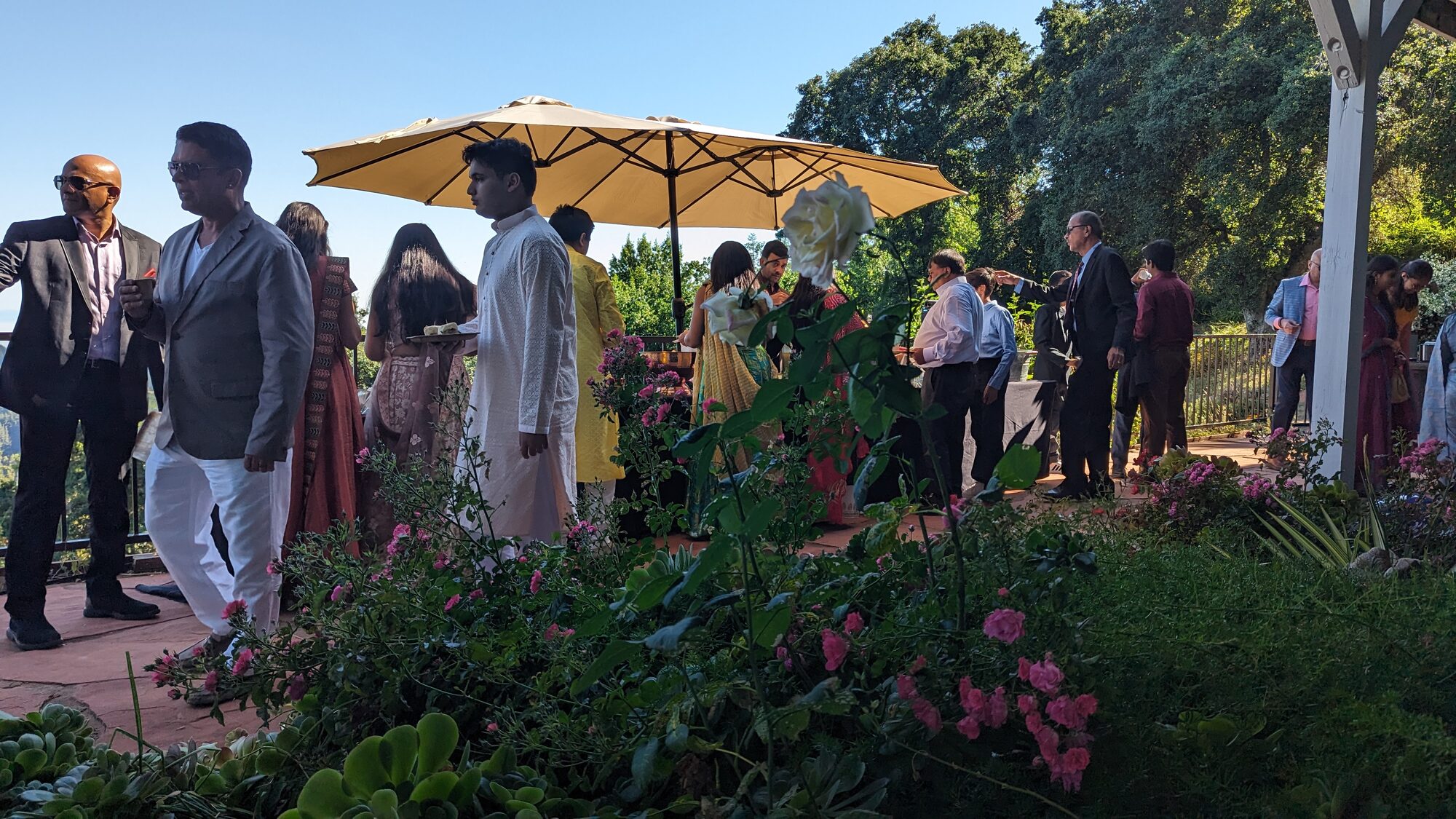
Here we run it on a large screen on a rolling cart, which can be positioned wherever it is needed: indoors, out on the deck, or beside the seating for the ceremony. The property has a lot of natural light and a lot of outdoor space, and a screen stays readable in daylight in a way a projected image does not.
Can we livestream for family who cannot travel?
Yes. Families do this often, usually for elderly relatives or family overseas, and the property has high-speed wifi with a 5G backup.
One piece of advice, learned from watching many of these: give the livestream to one person whose only job that day is the livestream. Not a family member who also has to speak. Not someone greeting guests. Any livestream anywhere can hiccup, and you want a person free to notice.
Can we bring ashes, and may we scatter them here?
Yes to both. Families are welcome to bring ashes, and they may be scattered in the forest on the property.
This is worth knowing because a great many venues will not allow it, and families often assume the answer is no and never ask. Having the scattering and the gathering happen in the same place, on the same day, spares everyone a second occasion months later, which is the part families most often tell us they were dreading.
There is no separate charge and no paperwork. Tell us when you book so we can talk through where in the forest feels right, and walk it with you beforehand if that would help.
Guests and accessibility
How many people will actually come?
Fewer than the number you invite, and the gap surprises people. A weekday service typically draws a little over half of those invited. A weekend service draws more.
Our property holds up to 80 guests, and that is a firm limit rather than a soft one, so if your list runs past 80 it is worth saying so early in the conversation.
Is the venue accessible for elderly guests and wheelchair users?
Yes, and this is one of the things we are most confident about. Memorial services skew older than almost any other kind of gathering, so this question comes up more here than anywhere else.
- The property is effectively step-free everywhere events happen: the deck, the indoor space, the ceremony areas, and the parking.
- There is an indoor ADA bathroom. This is usually the specific thing families are anxious about, and many outdoor venues cannot offer it.
- We will designate as many accessible parking spaces as your group needs, with no fixed limit. Just tell us ahead of the day so they are marked and ready.
- The only two areas with steps are the fruit orchard and the water feature, which are scenic extras rather than places a service happens.
There is parking for about 65 vehicles, shuttles are welcome to drop off and collect, and both Uber and Lyft come all the way up to the property rather than stopping at the road.
Should children come?
That is a family decision, and both answers are defensible. If children do come, one practical arrangement helps more than any amount of preparation: designate an adult who is not immediate family to be with them, so a child who needs to leave the ceremony has someone to leave with, and the parents do not have to choose between their child and the eulogy.
The practical part
What does it cost, and does a memorial cost less than a wedding?
A memorial costs exactly the same as anything else, because we price on one thing only: how late in the day your booking runs. Not event type, not guest count.
There are three blocks and every one of them begins at 9:00 AM. You choose only when the day ends:
- Half Day, 9:00 AM to 3:00 PM
- Afternoon, 9:00 AM to 6:00 PM
- Evening, 9:00 AM to 9:00 PM
Most memorial services fit comfortably into the Half Day or Afternoon block. Monday through Thursday bookings take $1,000 off, and memorials are more often on weekdays than weddings are, so most families here land in the lower column. Every price is published on our three booking blocks and what each one costs. Event insurance is included on every booking with no exceptions and no threshold.
What about food?
You bring your own caterer, or your own family, and there is no restriction and no approved list.
The kitchen has a large freezer, a full-sized refrigerator, a microwave, prep tables, and a sink. There is no stove or oven, so plan for food that arrives ready or is finished off site. Dining sets are $50 for a table with eight chairs, including setup, breakdown, and cleaning, with no delivery fee and no rental minimum. Linens are not provided and there is no laundry on site, so add those to your caterer's list or rent them separately.
How far ahead do we need to book?
Less far ahead than a wedding, and it is always worth asking even for a near date.
Memorial services often come together in two to four weeks, and weekday dates in particular open up at short notice. If you have a date in mind, call or text (408) 502-6409, which is the fastest route for anything soon.
Can we still gather after the formal part ends?
Yes, and you should. The property is yours until your block ends, not until the ceremony ends.
Families frequently drift from the ceremony to food on the deck and then to the fire pit as the light goes, which is often when the best conversations of the day happen. Nobody will hurry you toward the parking lot. When your block does end, our cleaning works around your vendors rather than the other way around, and load-out has no fixed deadline.
If you are the one holding this together
You did not ask for this job, and doing it well is genuinely hard. A few things worth hearing:
You cannot get this wrong in the way you are afraid of. Nobody attending is grading the running order. They came because they loved the same person you did.
Delegate more than feels natural. There is always someone in the wider circle who badly wants to help and does not know how to offer, and handing them the photo slideshow or the parking or the catering call is a kindness to them as much as to you.
And take the tour before you decide. Standing in a place tells you in about ninety seconds what a website cannot. You are welcome to schedule a quiet visit to the property, and we keep memorial tours unhurried and off to the side of anything else happening that day.
If you want a quieter overview of our memorial and celebration of life services before you visit, that page is a good place to start. Families comparing settings can also start with our guide to celebration of life venues in the Bay Area.